
RTP, return to player, is the most quoted and most misunderstood number in slots. Players see "96.5%" and imagine it says something about their next session. It does not. What it does tell you is still useful, especially at sweepstakes casinos where the same game can be set differently from one site to the next.
What RTP means
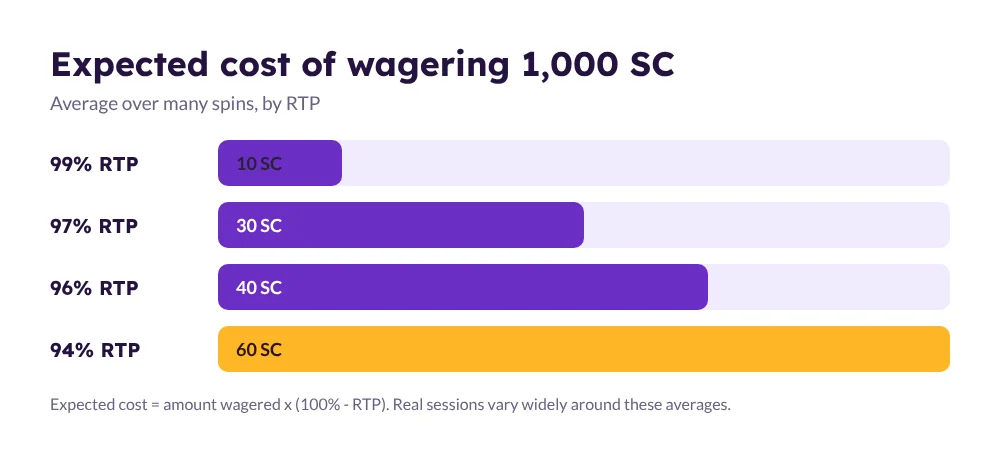
RTP is the share of all money bet on a game that it pays back over a very large number of spins, often millions. A 96% slot pays back $96 for every $100 wagered on average, keeping $4 as the house edge. Over a few hundred spins, actual results swing far above and below that figure.
Why it matters more at sweepstakes casinos
Two reasons. First, playthrough: every Sweeps Coin you must wager costs you the house edge on average, so a lower-RTP game makes free coins harder to turn into redeemable ones. Second, settings: many studios sell the same slot at several RTP levels, and each casino chooses one. A game can be 96.5% at one site and 94% at another, with nothing on the tile to tell you.
RTP, volatility and hit frequency
| Number | What it tells you | What it does not |
|---|---|---|
| RTP | Long-run average return | How a single session will go |
| Volatility | How big and how rare wins tend to be | When a big win will come |
| Hit frequency | How often any win lands | How big wins are |
| Max win | The largest possible payout | How likely it is (usually very unlikely) |
For small Sweeps Coin balances, volatility usually matters more than a point of RTP. A low-volatility 95% slot keeps a 5 SC balance alive longer than a high-volatility 97% one.
Typical RTPs by game type
- Slots: mostly 94% to 97%; around 96% is common.
- Scratch cards: often lower; Hacksaw's scratch cards at Stake.us sit around 92%.
- Crash and Originals: often 97% to 99%; Stake's Crash has a 1% house edge.
- Live blackjack: about 99.5% with correct basic strategy and standard rules.
- Jackpot slots: part of each bet funds the jackpot, so the base game returns less.
"This casino's slots don't hit"
Forum threads are full of players convinced that a particular site plays tighter. One experienced SweepsKings forum member keeps notes across sister sites and says some games hit far less often for him at one site than another. Individual experience cannot prove much statistically, but the underlying point is real: if a studio offers several RTP settings, two casinos can run different ones. Comparing the RTP shown in the game info at each site is the only way to know.
Other threads blame studios. In 2026 players argued about BGaming's results and warned each other away from specific new releases, like a Playson pot game. Read early player reports on brand-new slots before spending SC on them, and remember that a bad run is the most common outcome of high-volatility play.
Using RTP sensibly
- Check the RTP in the game info before playing Sweeps Coins.
- Prefer 96% or higher when clearing playthrough.
- Pick volatility to suit your balance: lower for small balances.
- Use Gold Coins to learn how a game behaves.
- Ignore "hot" and "cold" labels; each spin is independent.

 Lucky.Me 20,000 GC + 2 Free SCGet 2 free SC
 Splash Coins 150,000 GC + 2 Free SCGet 2 free SC
 Rolla Casino 500,000 GC + 10 Free SCGet 10 free SC
 KingPrize 30,000 GC + 2.5 Free SCGet 2.5 free SC
 Stake.us 250,000 GC + 25 Free SCGet 25 free SC
Quick answers
What is a good RTP at a sweepstakes casino?
Around 96% or higher for slots. Some casino-made games like crash can reach 99%.
Can the same slot have different RTPs at different casinos?
Yes. Many studios offer several RTP settings and each casino chooses one. Check the game's info screen at your casino.
Does RTP predict my session?
No. RTP is an average over millions of spins. A single session can end far above or below it.